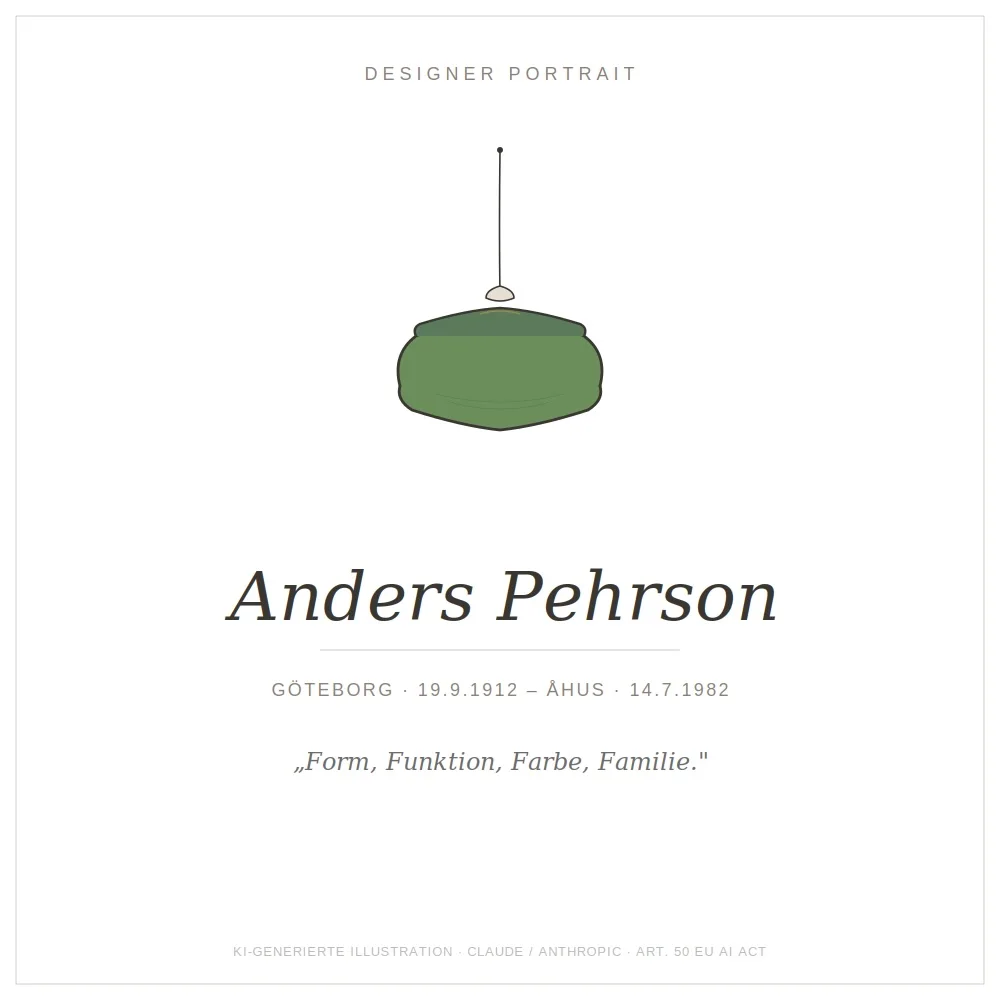
From engineer to lighting designer:Karl Anders Pehrson was born on 19 September 1912 in Gothenburg. After studying engineering in his home city, he worked from 1952 to 1963 as design manager and designer at AB Philips – a training that shaped his outlook: for him, light was not a decorative object but a matter of function, ergonomics and optical control.In the early 1960s, the Philips design manager received the offer to take over the entire operation of Ateljé Lyktan in Åhus. The tradition-rich firm, founded in 1934 by Hans Bergström in Helsingborg and later based in Åhus, needed a fresh start. Pehrson carried out the decisive change of course: away from artisanal one-off production, towards the industrial series production of the best-selling models – with an international orientation.
The four F's: Form, Function, Colour, Family:
Pehrson's working philosophy could be reduced to four terms that he pursued almost obsessively: Form, Function, Colour and Family (Form, Funktion, Farbe, Familie). "Family" referred to entire product families – a single lamp idea, consistently declined as pendant, floor, table and wall lamp, in many sizes and colours. His credo: "Good light is not always a lot of light, but always several light sources."
Bumling: A candle holder as ancestorCuriously, the origin story of the Bumling does not begin with Pehrson himself. In the late 1950s, company founder Hans Bergström simply turned a canopy – the cover that conceals the hook and electrical connection on pendant lamps – upside down and from it derived the basic form of a candle holder: model 100L, known today as Ofir. Ten years later, this very form provided the inspiration for the Bumling – the kinship is unmistakable, right down to the small outward curve at the upper edge, which on the candle holder stabilised the glass and on the Bumling became a purely aesthetic feature."That's quite a bumling to me!" – a boulder – a friend of Pehrson's is said to have exclaimed when the first example was shown in 1968 at the lighting fair in Gothenburg: round, over half a metre wide and hand-lacquered in green Serva lacquer. At a time when Swedish lamps were small and restrained in colour, the Bumling became a sensation – and one of the greatest successes in Swedish lighting history. The family grew quickly: six sizes, many colours, pendant, floor, table and wall lamps, even a Bumling table based on the 600 mm shade. Demand was so great that Ateljé Lyktan had to subcontract part of the production. To this day, the Bumling is part of the collection and is made in Åhus.In parallel, the Supertube was created in 1967 – a lighting system whose tubes could be extended into long runs of light via straight, curved and angled connectors, and which rotated through 360 degrees. It, too, became an enormous sales success.
Further designs by Pehrson:Simris (also called Olympia, 1964), Rampling (1966), Fungus (1969), Crystal (1970), Knubbling (1971), Tube (1973) and Sovo (1978); 781 Simris/Olympia 1964, Rampling 1966.
Olympia 1972: The late revengeFollowing a lighting exhibition in Copenhagen in 1970, Pehrson was invited to submit a lighting concept for the 1972 Summer Olympics in Munich. His concept was based on the 591 Simris table lamp and the 781 Simris floor lamp. In 1972, Ateljé Lyktan supplied 16,300 white-lacquered luminaires for the Olympic Village – in numerical terms the largest order in the company's history and Pehrson's international breakthrough. For the man who had missed the leap into the Olympic squad in 1936, it must have been a special moment.Two years after the Games, in 1974, Pehrson sold Ateljé Lyktan to the Fagerhult Group – but remained managing director, artistic director and marketing manager throughout the 1970s.
In 1977, production had outgrown the old works: the new factory in Åhus was inaugurated by the newly crowned King Carl XVI Gustaf – Pehrson had himself photographed at the king's side. He died on 14 July 1982, a few months before his 70th birthday.
Museum recognition – and an afterlife on film:Pehrson's works – including the Bumling and the Supertube – are today represented in the Swedish National Museum. And his lamps have made a second career as props: Bumling floor lamps appear as set decoration in the Nordic-noir series "The Bridge" (Bron/Broen), "Moscow Noir" (Dirigenten, Netflix) and the Icelandic crime series "Case" – a quiet testament to how strongly this design language has shaped Scandinavian interiors.
Anders Pehrson at Max's Vintage Art
References:
Ateljé Lyktan (official): "Design Classics" – atelje-lyktan.se/en/discover/design-classics →Ateljé Lyktan (official): "Our History" – atelje-lyktan.se/en/our-historyAteljé Lyktan (official): "Historical Luminaires" –Swedish Wikipedia: sv.wikipedia.org/wiki/Anders_PehrsonGerman Wikipedia: de.wikipedia.org/wiki/Anders_PehrsonNationalmuseum Stockholm: collection.nationalmuseum.sePamono designer biography: pamono.com/designers/anders-pehrsonVintageinfo.be: vintageinfo.be/anders-pehrson-bumling-floor-lampHemnet editorial: hemnet.se/artiklar